Graveyard Survey
Gravestone and Memorial Inscriptions: St Mary’s Olveston
A digital record
A project team from Olveston Parish Historical Society has transcribed and made a digital record of all the gravestone and memorial inscriptions in St Mary’s church and churchyard.
Weathering
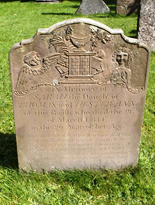
Over time, some of the inscriptions have been lost, either in part or entirely, and are still being lost, as the memorials weather and decay. In many cases, the headstones are carved from sandstone which, over the course of time, loses its surface layer by a natural weathering process called ‘exfoliation’. It was in order to capture what remains, before further deterioration, that OPHS initiated this project.
Community effort
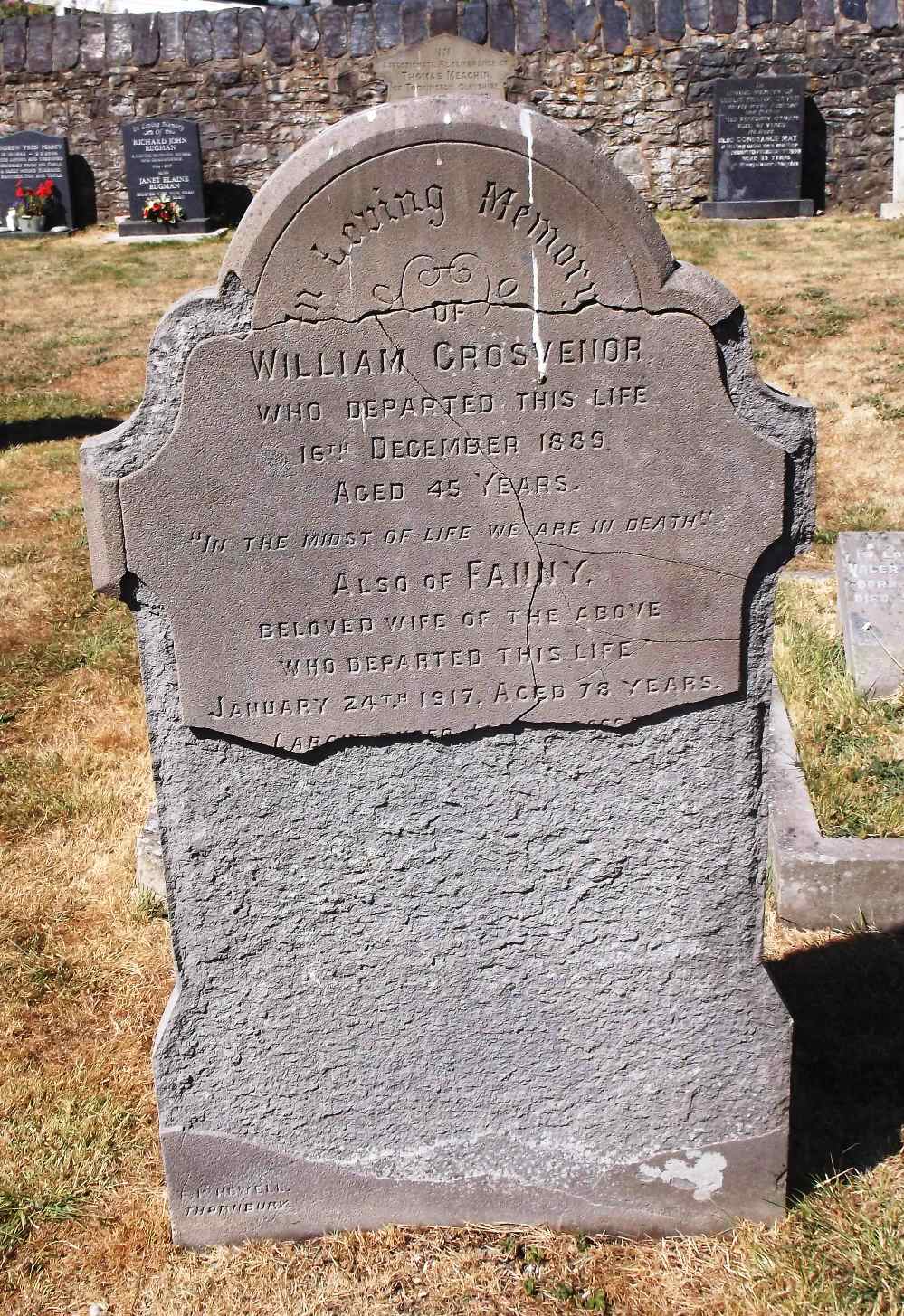
A terrific community effort, in which twenty local residents took part, has resulted in all the surviving information from the gravestones being transcribed and the positions of all the graves remapped.
The team has surveyed and recorded 969 gravestones and 85 memorials of interments of ashes. We have photographed more than 300 memorials. We should like to photograph all the gravestones and memorials and put these images on the website alongside the transcriptions.
A rich resource
We hope that the information presented here will provide a rich resource for parish and family history.
What to do next
Please use the links below to find out more about the project and to discover how to search for a particular person’s grave. Clicking on each link will open a pdf file, which you can either look at online or which you can save to a Graveyard folder on your own computer and view from there.
Churchyard Plan (Zoom in, to read the numbers.)
Publications
If you would like to buy any of the Society's publications, please contact Richard Newley on 01454 202011.
Here are Olveston Parish Historical Society's publications:
'FOR THE LOVE OF OLVESTON' by STEVE HUMPHRIES
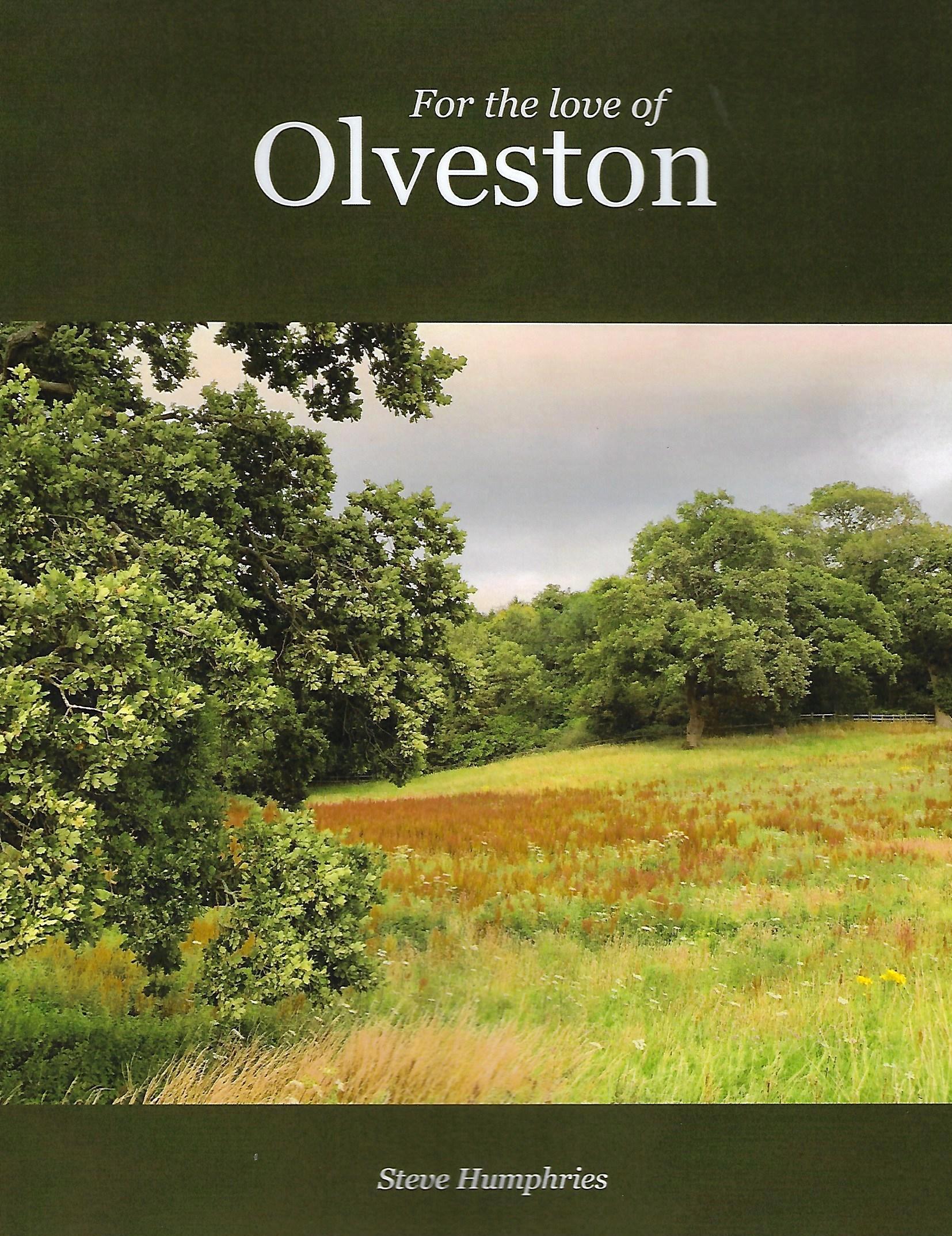
This newly published book, written by Steve Humphries, tells the story of the parish through the memories of Eric Garrett, Jean Panes, Nigel Dawes, Ted Addis, Angela Shepherd and other local people aged around ninety, whom Steve (an acclaimed oral history documentary film maker and author) has recently interviewed.
Illustrated with over 100 photographs, the book can be bought for £10, through Olveston Parish Historical Society, to whom Steve is generously donating any profits. The first two print runs sold out but we have had a recent reprint and copies of the book are now available again. Don't miss out!
To buy a copy of the book, please ring Jenny or Richard on 01454 202011
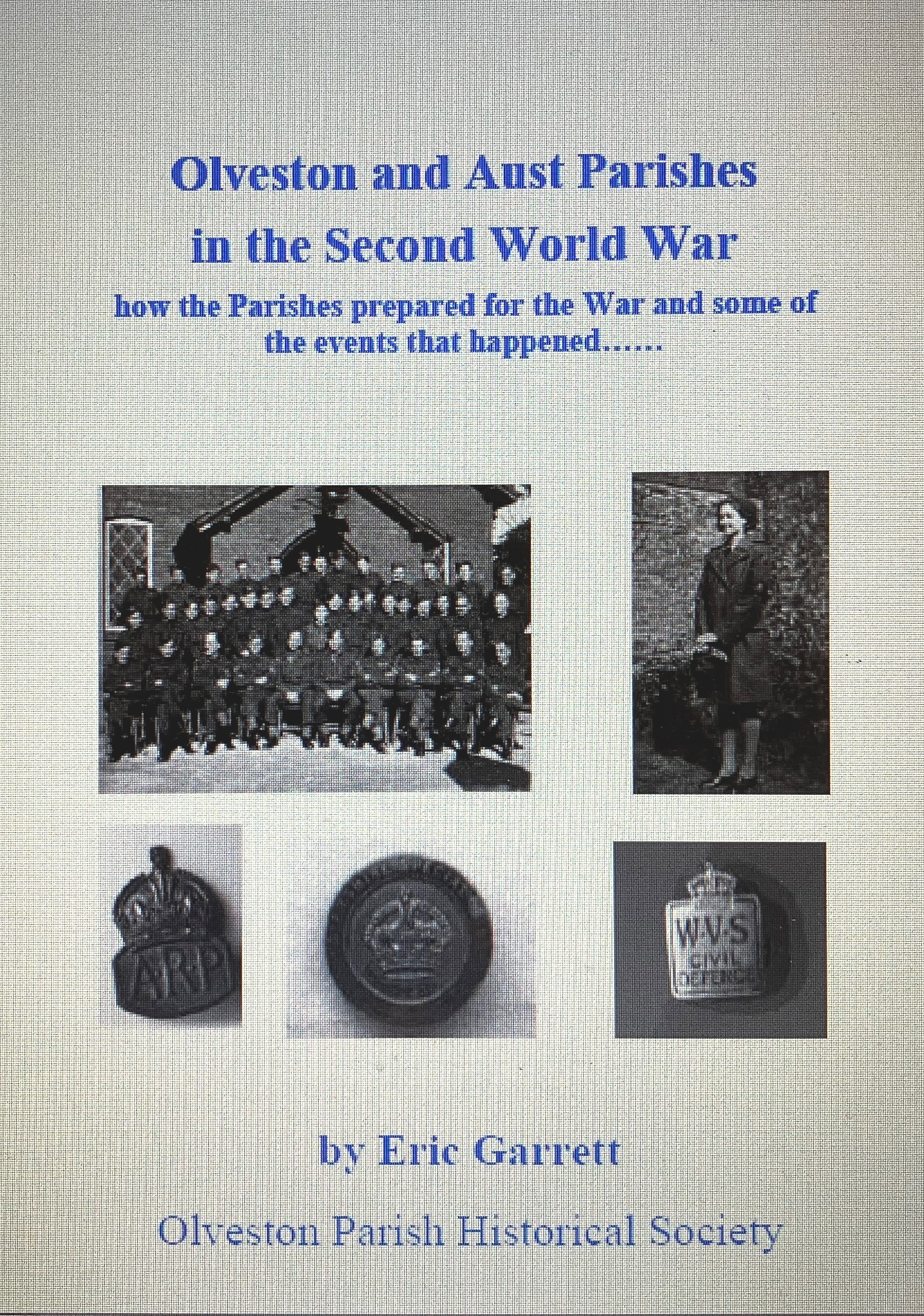
OLVESTON AND AUST PARISHES IN THE SECOND WORLD WAR by Eric Garrett
How the parishes prepared for the war and some of the local events that happened during War 2.
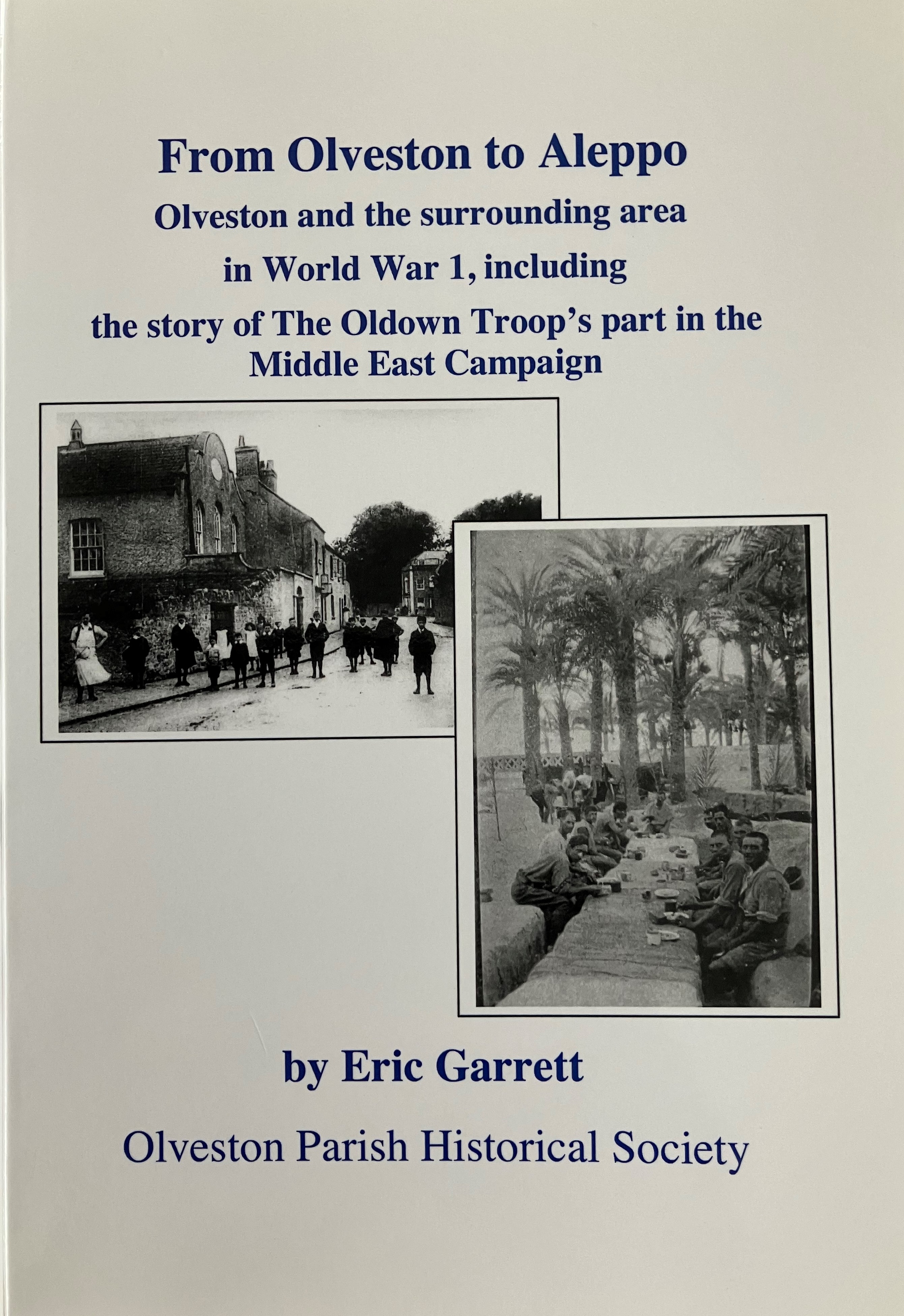
FROM OLVESTON TO ALEPPO: A HISTORY OF OLVESTON & THE SURROUNDING AREA IN WORLD WAR 1, INCLUDING THE STORY OF THE OLDOWN TROOP'S PART IN THE MIDDLE EAST CAMPAIGN by Eric Garrett
The War Memorial Book - Published 2006 - compiled by William Morgan
The War Memorial Book for The Parishes of Olveston & Aust, South Gloucestershire was compiled by William Morgan, a member of the Society.
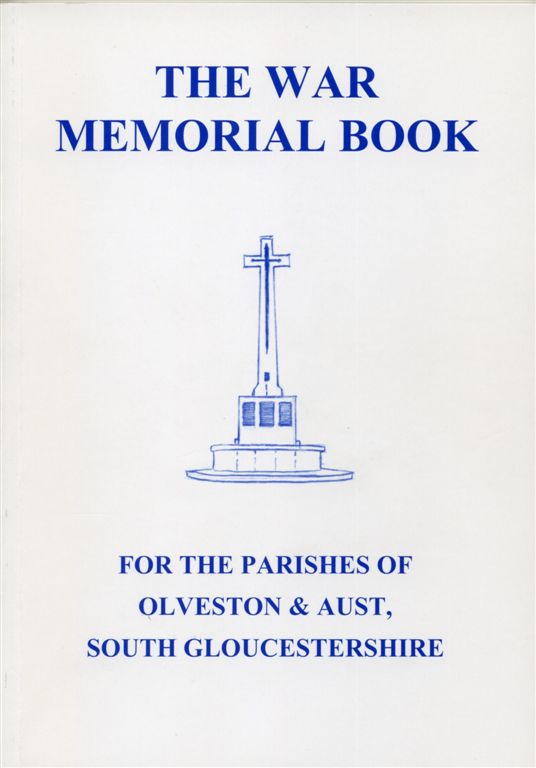
The book chronicles the story of those from two neighbouring civil parishes who gave their lives in the two great world wars of the twentieth century, and who are remembered in one of the four churches that serve these parishes.
Copiously illustrated, the entries for each name commemorated tell something of the appalling horror and waste so typical of those wars, but also of the camaraderie and courage displayed by so many ordinary village folk. There are accounts, too, of what it was like on the home front, including at a local manor house turned hospital, of a civilian casualty in World War II, and of one man who died in the Korean War.
The research and production of this book was funded by a grant from the Local Heritage Initiative. The book forms one part of the project "The People of Olveston and Aust in Peace and War". The local Heritage Initiative is a partnership between the Heritage Lottery Fund, Nationwide Building Society and the Countryside Agency.
OLVESTON AND TOCKINGTON WOMEN'S INSTITUTE - THE FIRST 20 YEARS - 1918 TO 1938 compiled by Anne Boulton from the minutes of the W.I.
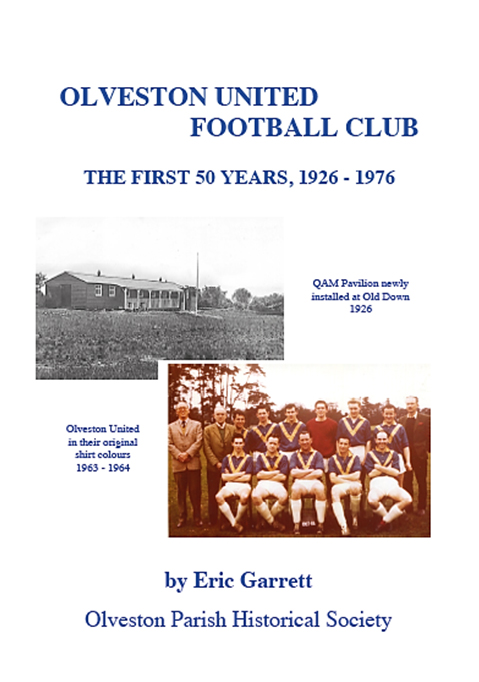
OLVESTON UNITED FOOTBALL CLUB, 1926 -1976 by Eric garretG
The story of our local football club .... published in 2017, the year the Club won the Cup Final to become the Glos. Football Association Senior Amateur Champions. That's a long way from some mates kicking an inflated sheep's bladder around on rough grass in the mid-1920s. Buy the book and read the first 50 years of the Club's history!
The History of Olveston Schools from 1836 to 1968 by Eric Garrett - published 2011
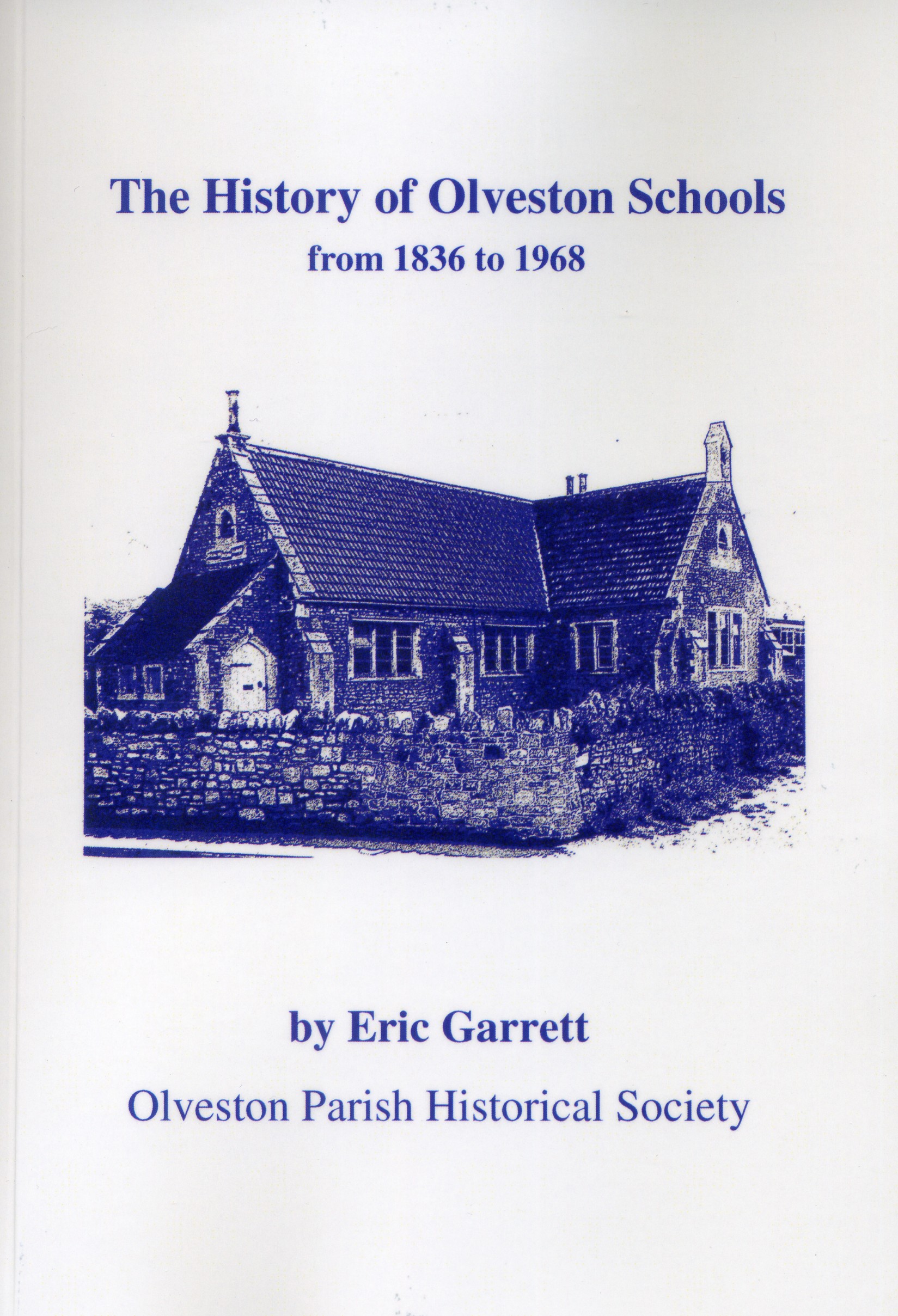
Using personal recollections and extensive archival research, this book paints a picture of the development of village schools in a rural community in the nineteenth and twentieth centuries. The Victorian period is brought to life by selections from old school log books kept by the headteachers and by the minutes of the management committee of local people who ran the schools before they were taken over by local education authorities. A splendid range of photographs, the earliest dating from 1871, show buildings, pupils and teachers from different eras. Photos of classes from the 1930s, 1940s and 1950s have captions which list mnay familiar local surnames. At Eric's launch talk on the subject, local residents were engrossed in spotting photos of family members, former teachers and classmates. A perfect present at just £8!
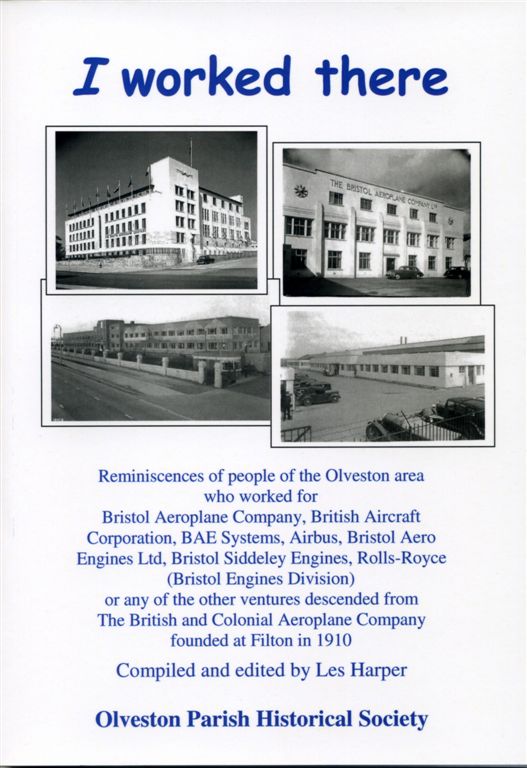
I worked there - Published 2010
Reminiscences of people of the Olveston area who worked for Bristol Aeroplane Company, British Aircraft Corporation, BAE Systems, Airbus, Bristol Aero Engines Ltd, Bristol Siddeley Engines, Rolls-Royce (Bristol Engines Division) or any of the other ventures descended from The British and Colonial Aeroplane Company founded at Filton in 1910.
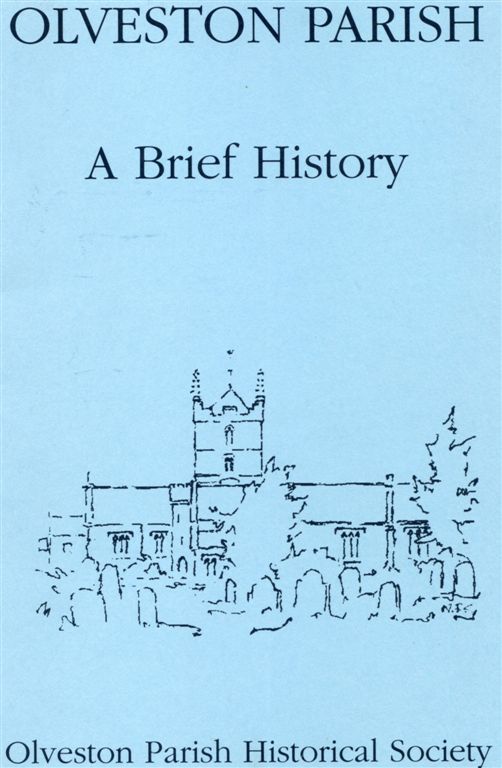
Olveston Parish - A Brief History - Published 1995
This 32 page booklet was produced by the Society with the object of providing those with an interest in the parish with an introduction to its long history.
It does not, for the most part, consist of a chronological narrative; instead it selects various features of the parish and its life and gives an account of how they developed. The booklet contains only a tiny fragment of the material held in the Society's archives.
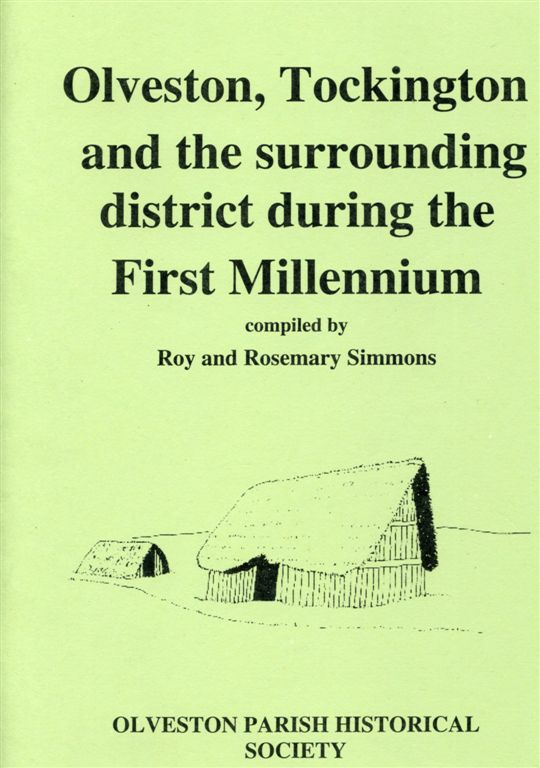
The First Millenium - Published 2000
Olveston, Tockington and the surrounding district during the First Millennium, to give it its full title.
Any history of Olveston which aspires to cover the period of the first Millennium A.D. must, to a large extent, be speculative or conjectural because solid evidence of early occupation is sparse. Our chief resource is the landscape itself and we must try to read the signs such occupation has left behind, using whatever clues have been left for us. Written evidence for this period is very scarce although for Olveston and several of the surrounding parishes we are fortunate in having Anglo-Saxon charters which set out the physical boundaries of Estates.
Alas, over the past 1100 years, although some landmarks are still detectable, others are frustratingly obscure and yet more, not surprisingly, have vanished altogether. Nevertheless, these charters make fascinating reading and using those features which are still traceable, we can feel we are reaching back over the centuries.
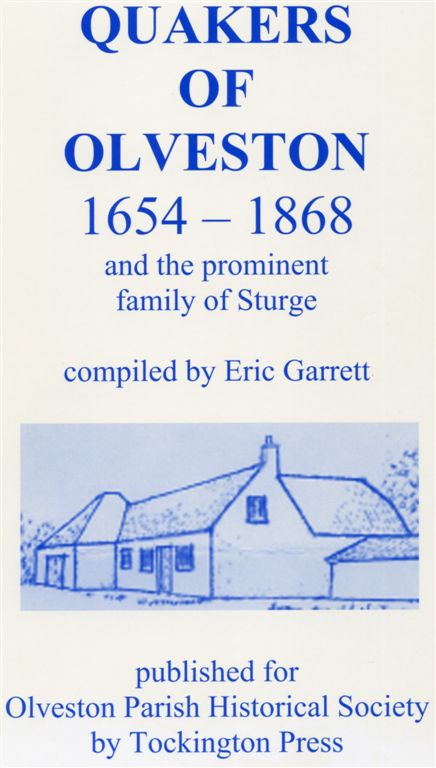
The Quakers of Olveston (1654-1868) - by Eric Garrett - Published 2005
For over two hundred years from the middle of the seventeenth century, in a period when the Church of England's influence in and around Olveston was at a relatively low ebb, non-conformism grew. Many yeomen farmers became Quakers and a Friend's Meeting House was established in Olveston (see Historical Buildings).
To trace this period and give it continuity, the Sturge family, who were Quaker elders throughout, has been used to provide an insight into the lives of these families.
In 1793, Joseph Sturge VI, the philanthropist and peace campaigner who became a national figure in the abolition of both the slave trade and the Corn Laws, was born into the Sturge family at Elberton Manor.
The research and production of this booklet was funded by a grant from the Local Heritage Initiative. The book forms one part of the project "The People of Olveston and Aust in Peace and War". The local Heritage Initiative is a partnership between the Heritage Lottery Fund, Nationwide Building Society and the Countryside Agency.
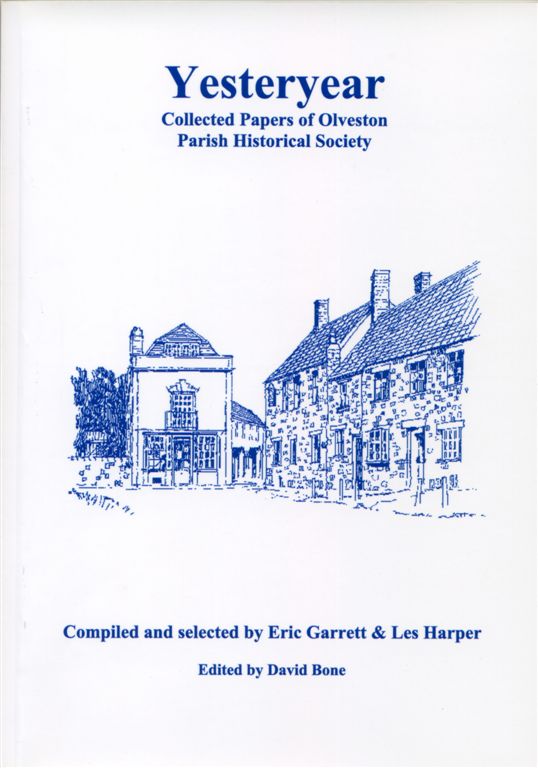
Yesteryear - First published 2006, reprinted 2011.
This is a fascinating collection of papers which are not large enough to justify individual publication.
They incude the appropriation of Olveston's early wealth by Bath Abbey; the "Fearful Newes" of the loss of Olveston's church steeple; one of the very first censuses taken in the country; the famous Tockington Regiment; the story of The White Hart Inn; the return of a Boer War hero and much, much more.
Historical Buildings
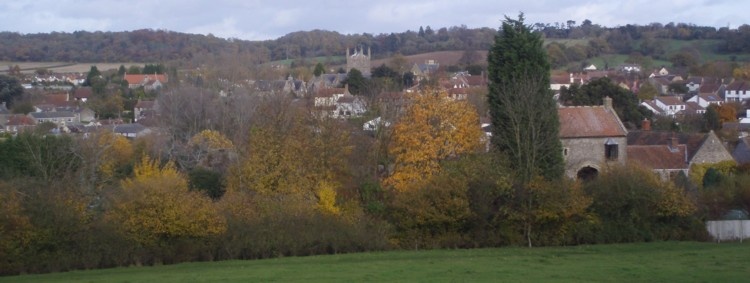
Olveston - A Panorama
In this picture, taken from the south west, you see most of the village and several of the buildings described below. Just right of centre is The Court and its adjacent buildings. Centre stage is St Mary's Church, and just to its right, The Old Vicarage. To the left can be seen the red tiles of the village's primary school. Hill House and The Meeting House are off to the right, not visible in this picture.
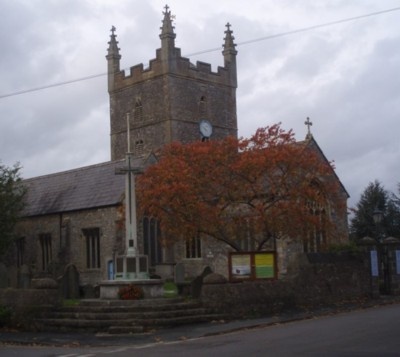
St Mary the Virgin Church
St Mary the Virgin, Olveston, seen here from the west, sits at the heart of the village, sharing the main crossroads with the White Hart, the former post office and Churchill House.
The Norman church, built about 1170, is thought to be on, or very close to, the site of a former church. St Mary's once boasted a spire, but this was destroyed by a great storm in 1604 and was never replaced.
St Mary's remains a very active centre of worship and holds services every Sunday. It is also a very popular venue for weddings.
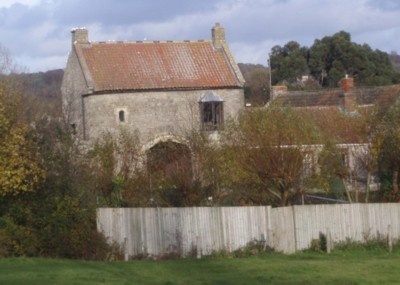
Olveston Court
Olveston Court, with its associated buildings, is situated to the west of the village and was formerly a fortified manor house. It can best be viewed from the footpath which leads from near the pump at The Green.
It was once a moated site and parts of the battlemented walls and moat remain, off to the left in this picture. Here we see the two-storeyed tudor gatehouse with its fine four-centred arch. The oriel window is a much more recent addition.
The nearby Great Barn and Bee Garden buildings were once part of the Court. All three are now private residences. The Court is but one of 54 listed buildings of special historical or architectural interest within the parish.
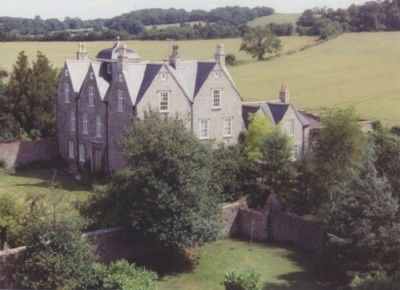
The Quakers - Elberton Manor
The early Quakers suffered extreme persecution for refusing to pay church tithes and swear oaths of allegiance to the Crown.
Joseph Sturge V, on marriage to Mary Marshall, moved to Elberton Manor in 1787. This house was previously owned by another Quaker family, the Goldneys.
Six children of Joseph were born at Elberton Manor, including Joseph Sturge VI the well known anti slavery campaigner and philanthropist.
This view is taken from the tower of nearby Elberton Church.
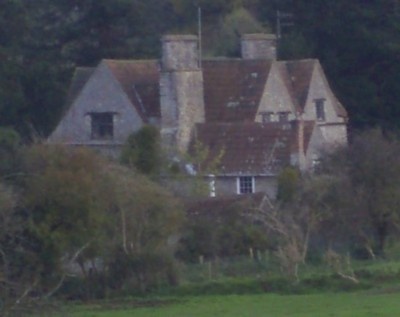
The Quakers- Hill House
George Fox, founder of the quakers, visited Olveston in 1660 and 1666 to initiate procedures for monthly meetings.
During these visits, he lodged at Hill House, The Green, as guest of William Rogers.
His third visit was special for him in that he married Judge Fell's widow, Margaret, at Broadmead, Bristol on 27th October 1669. Their two week honeymoon was spent at Hill House.
Quakers occupied Hill House in two separate periods - "Rogers" in the 17th century and "Sturge" in the 19th.
Here, we see Hill House from the south west.
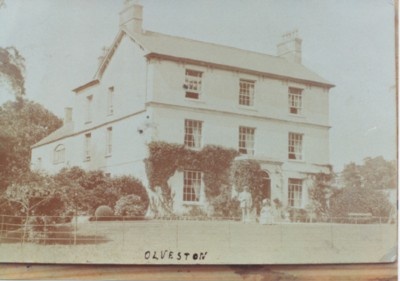
The Quakers - New Leaze
Joseph Sturge V and his family moved to a smaller farm, New Leaze, Olveston in 1809 for his retirement and the family remained there until 1820.
Members of the Sturge family built many of the cottages in the centre of Olveston, with several at the north side of Church Hill and in Ley Lane.
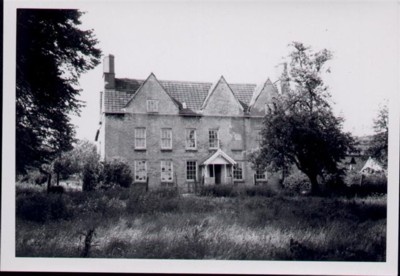
The Quakers - Sheepcombe
Joseph Sturge and his family moved to this larger farm, Sheepcombe Farm at Washing Pool Lane, Tockington in 1799, where six more of their children were born.
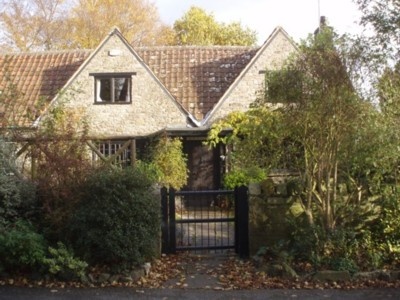
The Quakers - The Old Meeting House
Quakerism came to the locality following a visit to Olveston by John Audland and John Camm who spoke to a large gathering of farmers on Elberton Green in mid-September 1654.
Walter Clements of Olveston received the two preachers into the village whilst they were on their journey out of Bristol where they were crusading. Their speeches so inspired the farmers they formed a group to become Quakers. Olveston Parish at that time comprised 100 families, of which 40 parted from the established Church.
Early Quaker meetings were held at various farms until a farmhouse at The Green, Olveston was donated by William Rogers of Hill House in 1695 and enlarged into The Meeting House, which lies just across the road from Hill House. Today, the Meeting House is a private home.
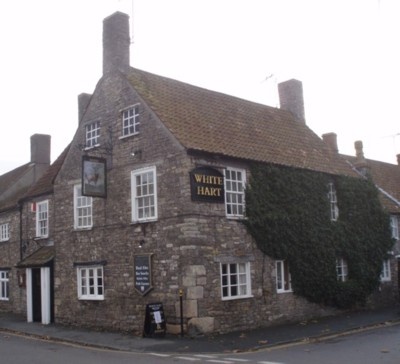
The White Hart
It is known that the White Hart, as an inn, existed in 1605 and that it was enlarged in the middle of that year.
Stone left over from rebuilding the nearby church tower (after the steeple burned down due to a lightening strike) and from the disused manor and chapel at Tockington were used. The font from the chapel was reputedly built into the front corner wall.
With the Aust Ferry Crossing only two miles further on, this was a popular stopping point for mail and other coaches when tidal or other river conditions made it impossible to cross to Wales.
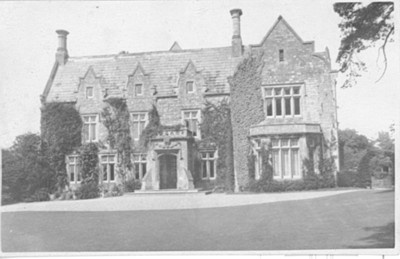
Woodhouse
Woodhouse was the home of Basil Harwood, the famous organist and composer of hymn tunes (for more on Harwood, see Publications).
It lies just below the A38, off Fern Hill, Tockington and has spectacular views across the Severn to The Forest of Dean, the estuary and Wales.
The land adjacent to the house is now used for Scout camps and other recreational purposes.
Tour of the Parish
The parish of Olveston consists of three villages (Olveston, Old Down and Tockington) and three hamlets (Ingst, Awkley and Lower Hazel).
Olveston Village
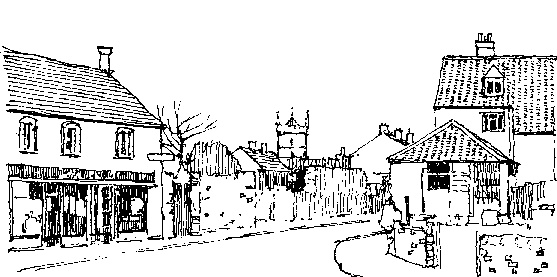
This picture shows The Street, the main road through the village of Olveston, with the tower of St. Mary the Virgin in the background. On the right of the picture is part of Cromwell House, one of the oldest houses in the village. Bottom left, and out of picture, the road leads via The Green to the 17th century Quaker Meeting House and, beyond that, past the village duck pond, to St Catherine's Hill. On the left can be seen the village's general store. Along The Street is the village baker. 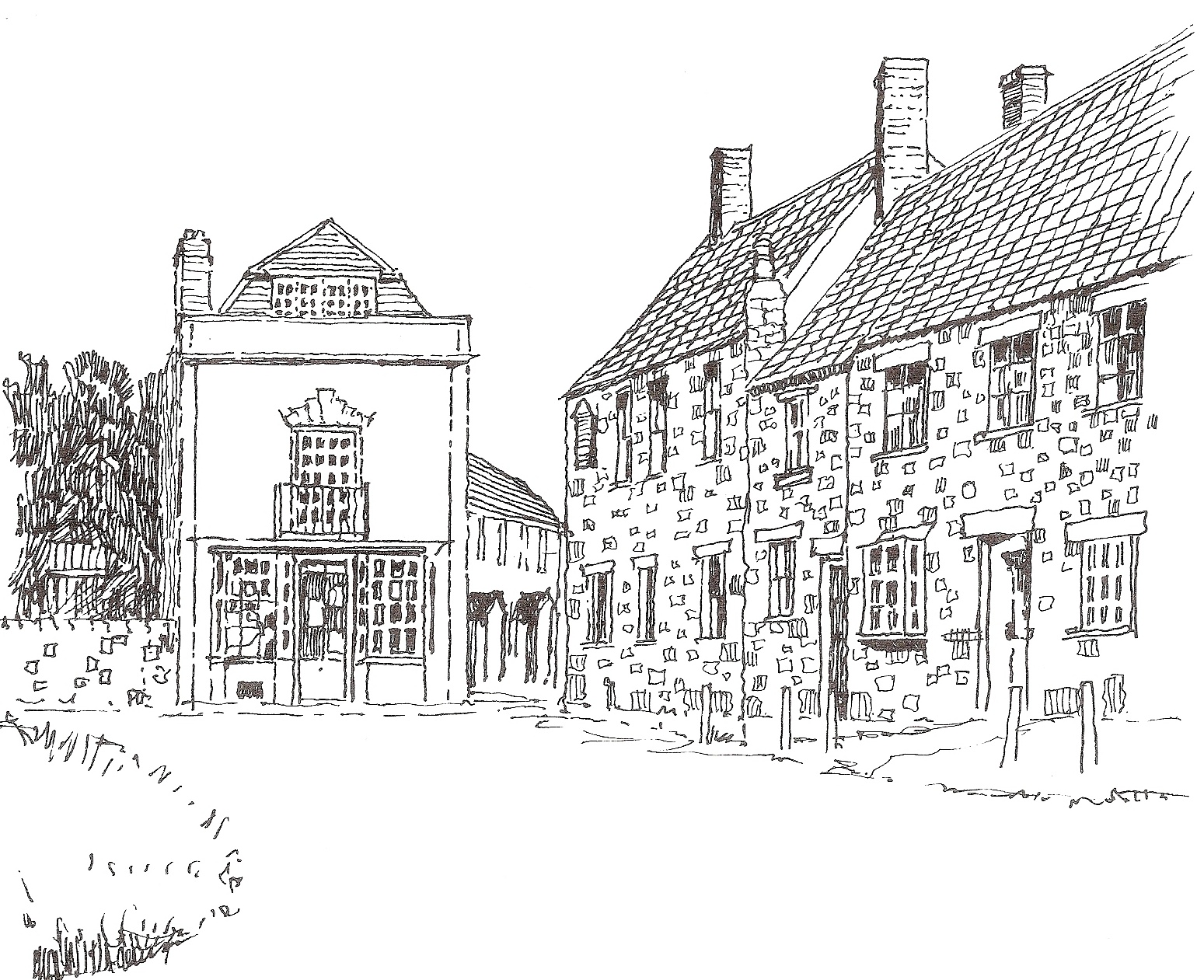
Further on is the main crossroads of The Street, Church Hill and Vicarage Lane, as seen here from Church Hill. Facing us is the old Post Office (now closed); on our right is The White Hart and, on our left, out of picture, St Mary the Virgin church. The old coach road to Aust Ferry goes off to the left. When tidal or weather conditions were against them, ferry passengers would stay at the White Hart.
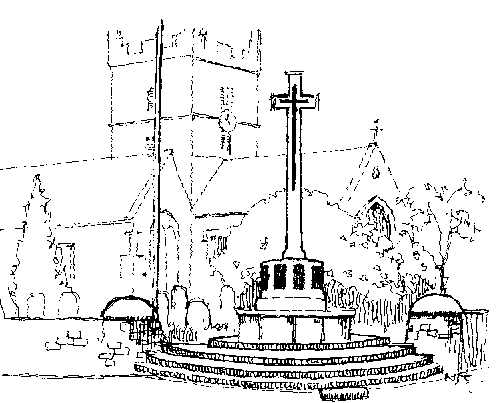
Here is a view of St Mary's, with the war memorial, as seen from the former Post Office.The church itself dates back to 1170, and is thought to be on, or very close to, the site of a much earlier Saxon church - recorded in 620. Rebuilding of the simple Norman cruciform structure began in 1370, resulting in considerable enlargement on the north and south sides (we are looking from the north east), leaving only the tower with its supporting arches of the original Norman building. The two-storey porch with the 'parvis' room above the south door, which had external stairs on the east side, is typical of the 14th century.
Thomas Haines, the schoolmaster at the time, wrote an account of a violent thunderstorm on the 28th November 1604, during which the needle spire was destroyed by fire and the five bells of the tower were lost. Visible above the clock is a tablet recording the rebuilding of the tower in 1606. The spire was replaced by an embattled parapet with pinnacles. A ring of five bells was cast at Chepstow in 1732 and a sixth was cast in London in 1811. The six bells were recast in Loughborough in 1907 to give the present ring of eight.
The original Norman font was replaced by a copy in 1871. The present font, which is Norman, came from a disused church. There is an elegant three tier chandelier of the 18th century, a gift from Bristol Cathedral.
Tockington Village 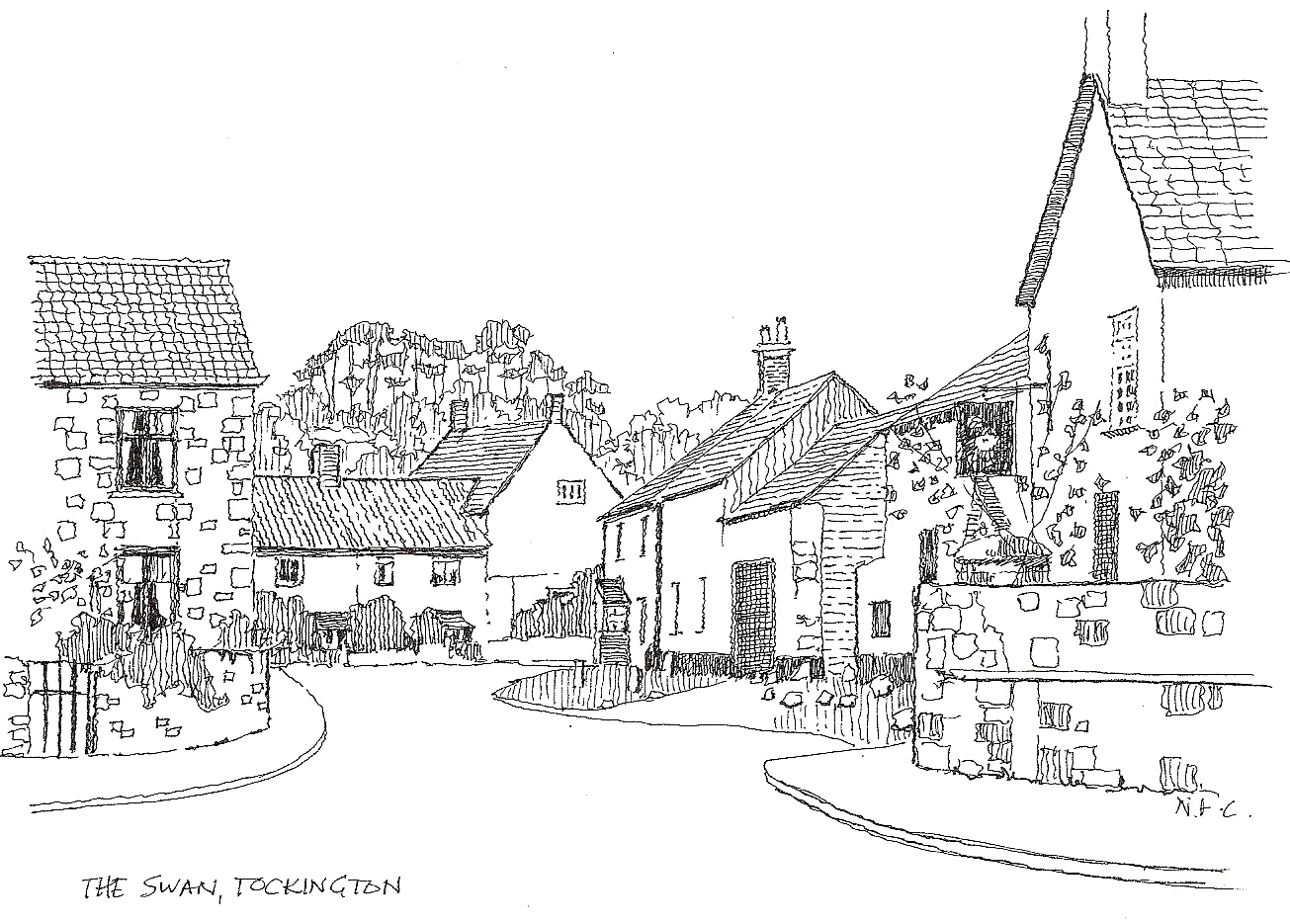
One of your first views of the Parish of Olveston, after driving down Fern Hill from the A38, will be The Swan, the seventeenth century inn on the right of this picture. With the White Hart at Olveston and The Fox at Old Down, it is one of three inns which still survive in the parish.
Tockington is the most easterly of the villages in the parish. It is located at a triangular junction with The Green at its centre. The Green is shown in the sketch below. A Fayre has been held there each autumn for more years than anyone can remember.
The spelling of Tockington has varied over the years. The Domesday Book records it as Tockintone, and later the name passed through Tokinton to Toketon and then Tockington.
The road directly ahead leads on to Olveston and, beyond, to Aust. Behind the houses on the right is the site of the original manor house, now long gone, which was home to the Lords of The Manor of Tockington.
At the centre of The Green, and shown in the centre of the sketch, is the site of an old cross where outside worship took place. 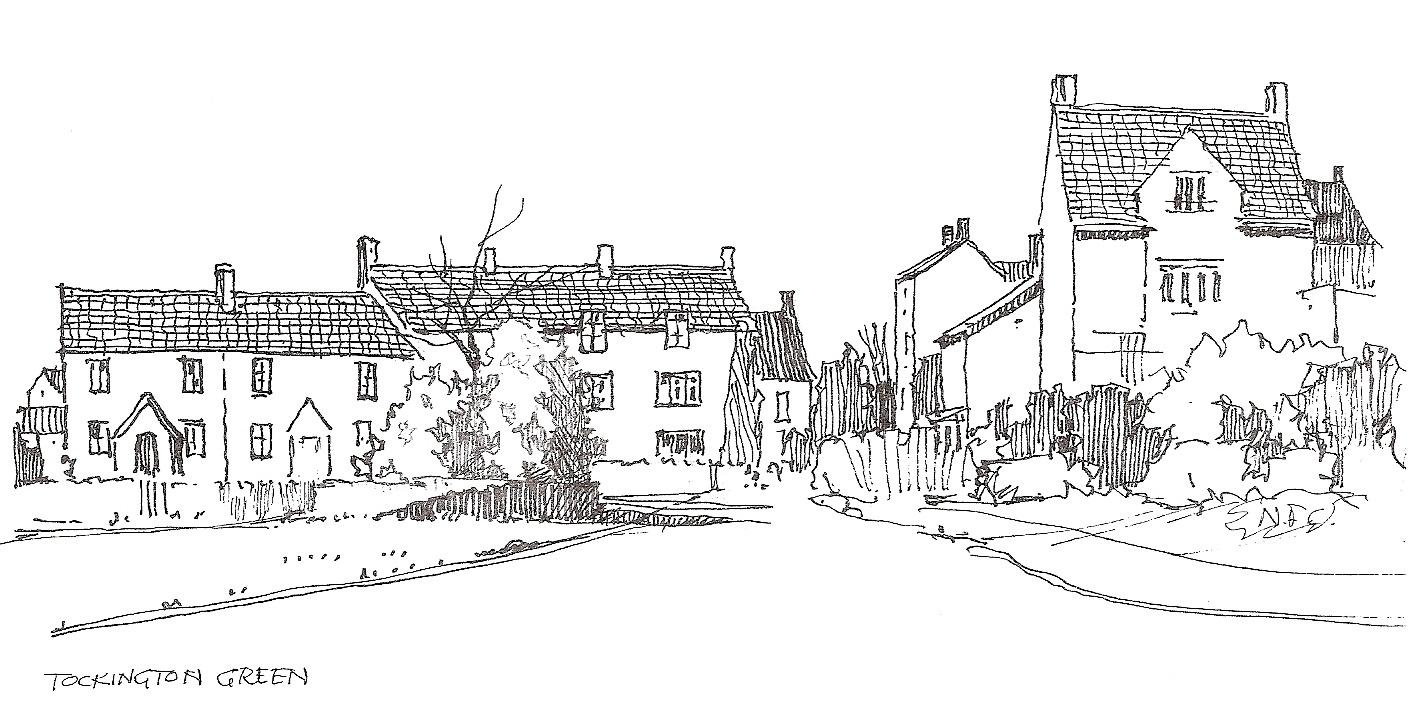
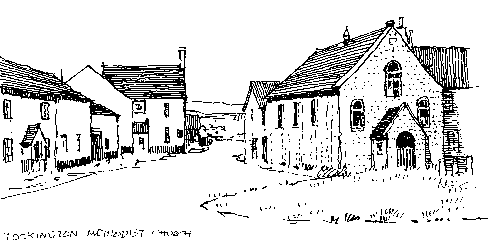
In the sketch below, we are looking back towards the Swan (on the left) from The Green, with the Methodist Chapel on the right. The edge of the green is in the foreground.
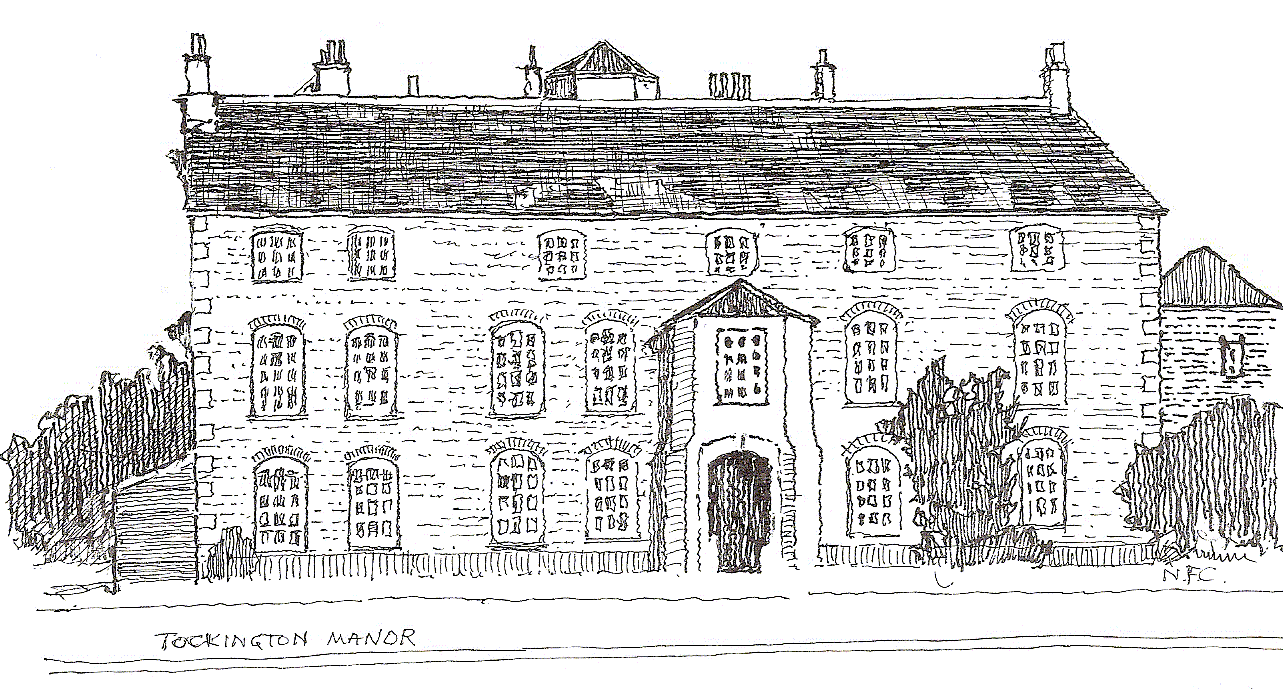
Tockington is also home to Tockington Manor School (shown below). The school opened in 1947 as a school for boys. Then it had 23 boys and a staff of 5, but it now caters for both boys and girls from two to fourteen years years and currently has 250 pupils.
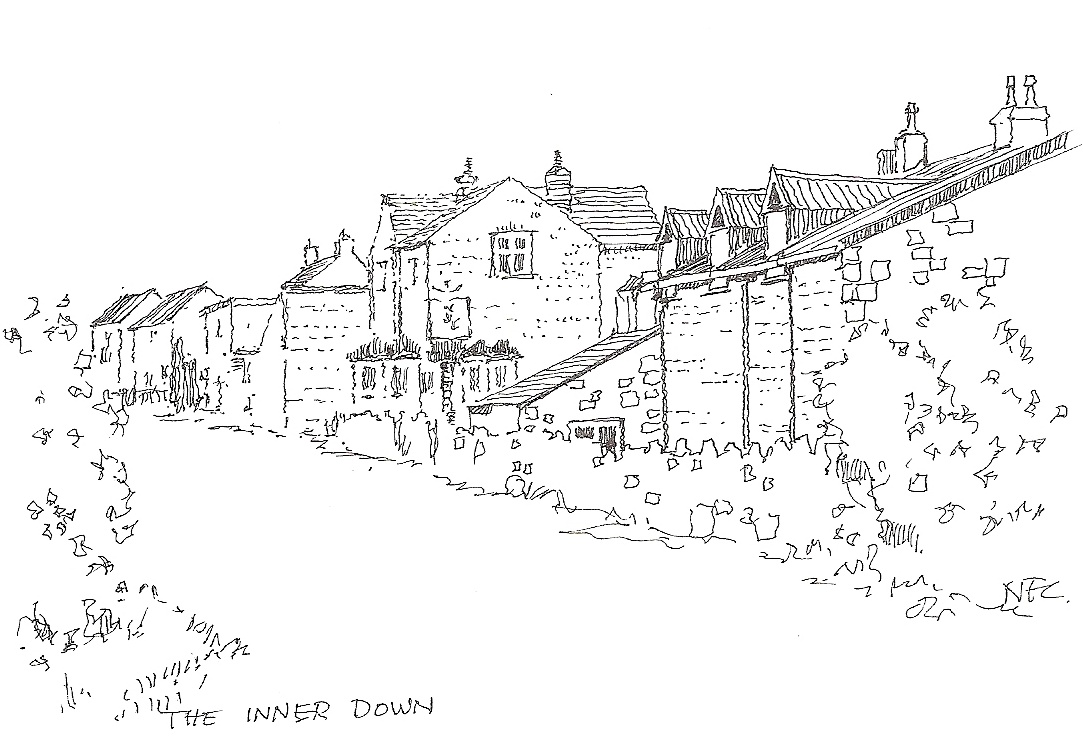
Old Down Village
Old Down sits on the high ground to the north of the parish on the road to Alveston and Thornbury. The edge of this heavily wooded hill is dotted with old lime kilns, the lime having been extracted from the several quarries which were worked in the last century.
Old Down has its own pub, The Fox (shown on the right in the foreground), as well as hosting several of the parish's sporting facilities - a cricket ground, football pitch and bowling green.
Olveston Scout Troop has its new hut at the top of Old Down Hill, tucked neatly into a wooded glade between the bowling green and the football pitch and adjacent to a play area.
Ingst Village
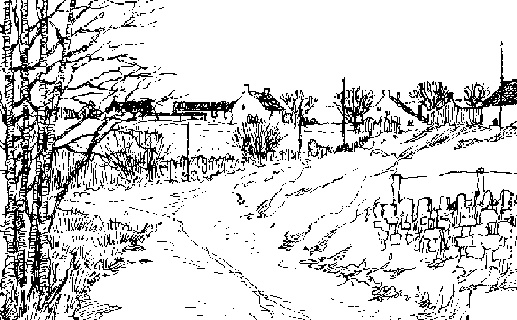
The small village of Ingst lies at the western edge of the parish.
While most parish names are from the Anglo-Saxon, Ingst is thought to derive from the Welsh ynys, or island.
This is a reminder that in Saxon times hereabouts was marshland and Ingst may well have been an island.
We are indebted to the late Neil Cairncross for all the sketches shown here and elsewhere on the OPHS pages.
A Brief History of Olveston
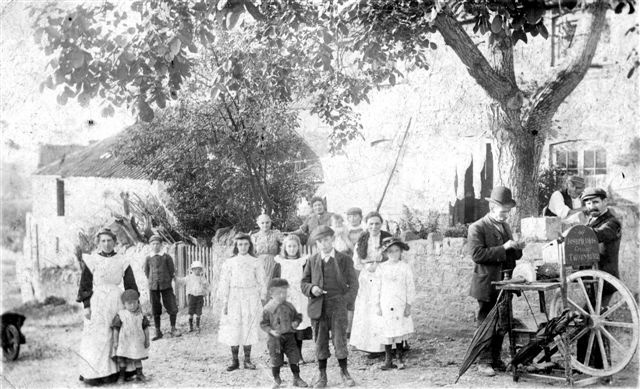
Olveston - Visit of a Knife Grinder
The parish of Olveston comprises Olveston, Tockington and Oldown. Its boundaries have changed little since Saxon times. Elberton was originally part of the parish, but became a part of Aust Parish, leaving Cote as an isolated part of Olveston: a curiosity which lasted until 1885.
Orginally, Tockington was not a part of the parish, but it had clearly become so by 1742. At that time the parish extended beyond the A38 to include Tockington Park Farm as well as old St. Helen's Church at Rudgeway. This area passed to Alveston in 1935, but a part of it was returned in 1988 when an area of the north east of Olveston Parish (Wolfridge) passed to Alveston Parish. At the same time, land to the south of Olveston was passed to Almondsbury.
The Domesday Book records 66 inhabitants in Olveston and Tockington villages at the end of the 11th century. The next record of population was made in 1711, when the two villages and surrounding land are recorded as having 240 inhabitants. The population rose rapidly over the next century and a half, reaching 1740 in 1871 but fell to 1240 in 1951. It peaked at 2550 before the 1988 boundary change. In the 2011 census it stood at 2033.
The name has changed many times over the centuries. Domesday has Alvestone, probably derived from the Old English Aelfestone - Aelf's Farmstead. In the 12th century the initial A was changed into an O. Up to the 17th century the name changed a dozen more times, passing through Ulvestone, Oldeston and Wolston to, eventually, Olveston.
In the 17th century, the village became home to several members of the Quakers - details can be found in our section "Historical Buildings."
History Links
Links to websites relevant to our local history
Here you can find a range of websites relating to our local history. Just click on the name to access the website.
- Avon Local History and Archaeology
- Bath and Avon Family History Society
- Bristol and Gloucestershire Archaeological Society
- Downend Local History Society
- Frenchay Village Museum
- GENUKI Family Research - Aust
- GENUKI Family Research - Elberton
- GENUKI Family Research - Olveston
- GENUKI Family Research - Redwick and Northwick
- History groups in the Thornbury area
- Kingswood Heritage Museum
- South Gloucestershire Mines Research Group
- Thornbury & District Museum
- Yate Heritage Centre